
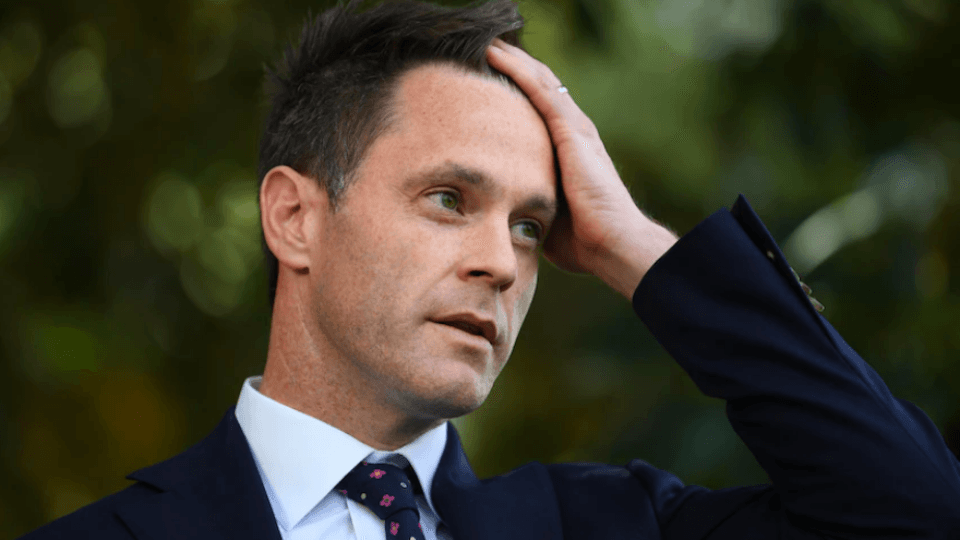

Here’s a fun game to play in lockdown: guess the name of the current NSW opposition leader. You get three tries. Give up? His name is Chris Minns, and, like the NSW Labor Party, he might as well not exist. Despite the Berejiklian government’s COVID clusterfuck, NSW’s Labor opposition has been virtually silent, having promised to “take politics out of the pandemic” as Minns put it in an interview on 2GB. That means that, despite a crying need for an approach that puts health before profits, what passes for an official opposition has quietly backed the government’s reckless policies.
NSW Labor were already adept at fading into the background, but during the last few weeks they have become totally invisible. “We promised not to score any political points, and we haven’t”, Minns proudly declared in his interview with 2GB’s Jim Wilson. He’s right. Labor have scored precisely zero political points. They should be shouting from the rooftops that Berejiklian has driven NSW to the brink of catastrophe, that working-class people across Sydney are being endangered by the government’s policies. They could condemn Berejiklian’s sadistic call to “learn to live with the virus”. They could push to eliminate the virus by applying a lockdown “marked by uniformity, clarity and strong financial and social support”, as epidemiologists at the Burnet Institute have argued in the Guardian recently.
Instead, bar a few minor criticisms, they have quietly toed the government’s line.
In the same interview, Minns expressed his sympathy for Berejiklian. He insisted that her decisions were “not political calls” and had “nothing to do with ideology”. That’s easy to say when he shares her core ideology, that the economy and profits are more important than public health.
Minns complains on social media that the real tragedy in the lockdown has been the loss of profits. In one video, he implored Sydneysiders to buy local when we order Uber Eats. Stop ordering Uber Eats from overseas, people: it’s hurting true blue Aussie restaurants!
Aside from the feeble criticism that the government should be publicising health advice, Labor’s positioning is indistinguishable from that of the Liberals and their media and business backers. They have all pushed the dangerous idea that relatively low vaccination targets can be a “roadmap” out of lockdown even while cases are out of control.
NSW Labor’s sycophantic position contrasts with some of the Labor state governments. In Victoria last year, Labor Premier Daniel Andrews initially fumbled around for weeks while case numbers increased. Eventually, his resolve stiffened by mass support for lockdowns, Andrews implemented and held to a lockdown, overriding intense opposition from business, the mainstream media and the Morrison government. The result was that COVID was, for a time, eliminated in Australia.
Labor Premier Mark McGowan has made himself the most popular politician in WA, and turned the WA Liberals into a minor party, by pursuing a policy of zero COVID, despite recent pressure from the National Cabinet to drop the goal. In these limited, fragile examples, Labor politicians have been pushed to act according to the science and mass popular opinion, against the squeals of the business class. But with the outbreak in NSW out of control, Morrison and Berejiklian are arguing that because “Delta is different”, we need to ease restrictions and “learn to live with the virus”. Neither federal nor NSW Labor have put an argument against this, and Daniel Andrews could easily buckle under the pressure with rising cases again in Victoria.
The Australian Labor Party is a fundamentally pro-capitalist party. Of all its state divisions, NSW Labor are probably the worst. They ruled the state from 1995 to 2009 and were notorious for corruption, privatisations and schemes to enrich property developers. They attacked workers’ rights, beefed up the police state and led racist anti-immigrant campaigns, particularly against Sydney’s Lebanese community. Since they moved into opposition, they have become virtually invisible because they are indistinguishable from their Liberal counterparts. Refusing to “play politics” is simply refusing to criticise the government in a way that might upset wealthy donors, the Murdoch press and, as Labor sees it, voters—although this hasn’t done them any favours in elections. They have rendered the official political landscape utterly barren, giving Berejiklian free rein to drive the state towards total catastrophe without fear of public criticism from her colleagues.
NSW Labor are in no sense a real political opposition to the Liberals. They have no desire to give expression to mass anger against the Liberals, and refuse to fight for public health over private profits.
In the latest outburst of national security hysteria, ASIO spy chief Mike Burgess declared, in a speech on 28 February, that an unnamed former Australian politician had betrayed our beloved country by clandestinely working for an evil foreign spy network—which he called “the A-team”—to provide secret information to a rival power.
Banyule City Council has become the eighth metro council in the Melbourne area to formally call for an immediate ceasefire in Gaza.
In a monumental betrayal, Melbourne University’s Students’ Council last month voted to rescind a motion supporting the Palestinian struggle for self-determination and the global Boycott, Divestment, Sanctions movement.
Nachshon Amir looks like a military man. It’s decades since he served in the Israeli military, but with his shaved head, fit physique and rugged demeanour, it might also seem that he has just been demobbed.
The facts are undeniable. Women in 5,000 companies—covering almost five million workers—earn 21.7 percent less than their male colleagues’ median total remuneration. In some companies, the gap is as high as 31.8 percent. This is according to figures released by the Workplace Gender Equity Agency (WGEA) in the lead-up to International Women’s Day this year.
Internationally, some major unions have responded to the cost-of-living crisis by taking serious industrial action. Though results have been mixed, the UK has seen the most significant wave of strikes since the 1980s. In the US, some workers have won significant breakthroughs—including wage rises of 80 percent or more for some university staff, and for low-paid United Auto Workers members after their nationwide “stand up” strike campaign last year.