
The Thin Red Line is a novel by James Jones set during the World War Two battle between the United States and Japan for control of the Solomon Islands. It is about the devastation war visits even on the “winners”; the title refers to the physical and mental fragility of human beings, which combat inevitably exposes with horrifying consequences. And it is about the hypocrisy and callousness of those who give the orders to fight without having to suffer those consequences.
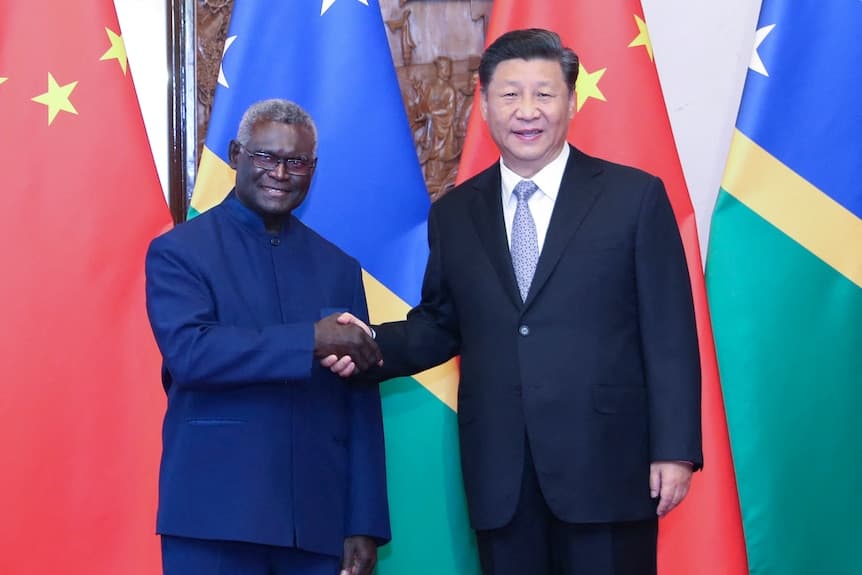
Prime Minister Scott Morrison recently declared a different sort of “red line” in the Solomons. “We won’t be having Chinese military naval bases in our region on our doorstep”, he fumed, after confirmation that the Solomon Islands and China had signed a new security treaty. It was a warning to China to back off from what the Australian government considers its exclusive sphere of influence. It also puts Solomon Islands Prime Minister Manasseh Sogavare on notice about the limits of acceptable behaviour on the part of junior members of what Australia patronisingly terms its “Pacific family”.
But if this red line were to be breached, would it mean war, or an invasion of the Solomon Islands? Neither Australia nor the United States will rule out the possibility. On Anzac Day, Defence Minister Peter Dutton bluntly told Australians “to prepare for war” to counter China’s rise.
Not to be outdone, Labor’s shadow minister for foreign affairs, Penny Wong, labelled the China-Solomons treaty Australia’s “worst foreign policy blunder in the Pacific since the end of World War Two”. To ward off China, Labor has pledged to train more security forces from Pacific nations and increase Australian maritime surveillance activities in the region. The single biggest argument between Labor and the Liberals in the election campaign to date is about who would be the more competent managers of Australian imperialism.
Presumably Jones’ novel has not been foremost in the minds of Australia’s leaders in recent days. But World War Two certainly has been. Victory on Guadalcanal and in the earlier battle of the Coral Sea, which lies between Australia and the Solomons, marked the moment when the Allies went on the offensive against Japan. By smashing Japan’s military power, the US established its current hegemony in the Asia-Pacific.
We are repeatedly told that the Solomon Islands are “just” 1,750 kilometres from Australia, as if their proximity means a Chinese presence there would physically threaten this country. There’s no serious prospect of that. The Solomons’ real strategic significance, now as in World War Two, is that they sit astride supply lines with the United States. By threatening to cut that link, a Chinese military base in the Solomons would constrain the role Australia could play in any conflict between the US and China, for example over Taiwan or in the South China Sea. It would weaken Australia militarily and reduce its utility as a base for US forces.
In other words, the Solomons matter little in themselves, but they play a role in the intensifying competition between China and the United States for regional dominance. The Australian ruling class benefits immensely from US power in Asia, which has guaranteed not only strategic stability but an economic architecture under which Australian exports to China, Japan, South Korea, Taiwan and South-East Asia have flourished. All this is threatened by China’s rise; hence Australia’s determination to preserve the current international order.
It should be noted that both Sogavare and China have disavowed any plans to establish a Chinese military base in the Solomon Islands. A leaked draft of their treaty suggests China would be permitted to deploy security forces to the Solomons only if the latter’s government asked for security assistance. That’s little different to an existing treaty between the Solomon Islands and Australia, which was invoked late last year when Australian soldiers and police were deployed after political unrest in the capital, Honiara. Little wonder Sogavare would seek an alternative source of international assistance, lest he becomes dependent on an Australian government that has made no secret of its disapproval of his friendly ties with China.
Australia repeatedly denounces China’s presence in the Pacific as threatening the sovereignty of smaller nations. Events in the Solomons give the lie to this rhetoric. Pacific nations are sovereign, but only if they exercise their sovereignty within the “red lines” laid down by Australia itself.
It’s the same story in Papua New Guinea. Australia is building a new naval base on Manus Island, which lies off PNG’s north coast. But rumours last year that China might construct a fishing port on the island of Daru in the Torres Strait caused panic in Australia, because it supposedly could provide cover for construction of a Chinese naval base.
So Australia reserves to itself the exclusive right to establish military bases in the South Pacific, under threat of war if other countries do the same. Put simply, the Pacific, in the eyes of those who run Australia, is “our backyard”, not China’s. It’s the same sort of imperialist logic that Vladimir Putin invokes to justify his brutal invasion of Ukraine: that NATO might construct military bases there that threaten Russia’s interests.
Beyond these staggering double standards lies an important reality. When Australia and the US talk about defending the “international rules-based order”, they mean maintaining their own positions at the top of the imperialist pecking order. They mean that every other country must obey the rules that they have established in their own interests.
With bitter irony, Jones dedicated The Thin Red Line to the “greatest and most heroic of all human endeavours, WAR and WARFARE”, which provide us “the heroes, the presidents and leaders, the monuments and museums which we erect to them in the name of PEACE”. Leaders like Morrison, Dutton and Wong, who are marching us ever deeper into a more dangerous future.
Measured by the sheer volume of stuff produced, capitalism is a very successful system. According to World Bank data, in 1960 global gross domestic product (GDP)—which measures the monetary value of goods and services sold—was just under US$1.4 trillion. By 2022 it had risen to $101 trillion. The world’s population has increased a lot in that time, but the volume of stuff produced has increased by far more.
As Israel’s latest brutal war against the people of Gaza drags on, the need to challenge the Zionist state and all those who facilitate its genocidal campaign couldn’t be clearer.
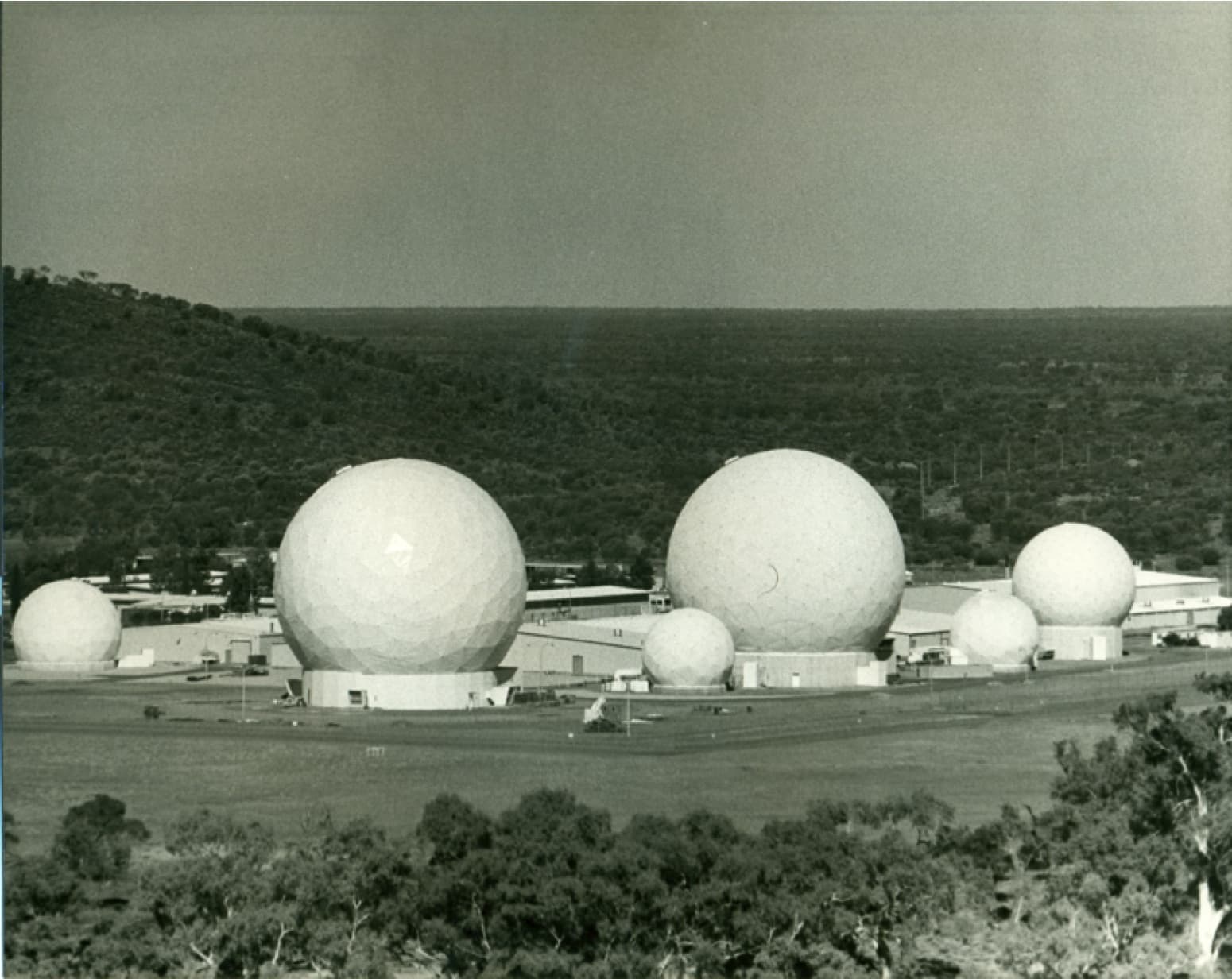
In the latest outburst of national security hysteria, ASIO spy chief Mike Burgess declared, in a speech on 28 February, that an unnamed former Australian politician had betrayed our beloved country by clandestinely working for an evil foreign spy network—which he called “the A-team”—to provide secret information to a rival power.
Banyule City Council has become the eighth metro council in the Melbourne area to formally call for an immediate ceasefire in Gaza.
In a monumental betrayal, Melbourne University’s Students’ Council last month voted to rescind a motion supporting the Palestinian struggle for self-determination and the global Boycott, Divestment, Sanctions movement.
The military ordered hundreds of thousands of people into a designated “safe” zone. On reaching it, they were shelled by the army and the air force. The generals said there was another safe zone; if the people kept moving, respite would be found. It wasn’t. Again they were attacked. The scene repeated, but now, corralled onto a tiny stretch of beach and trapped against the ocean, there was no way out.