
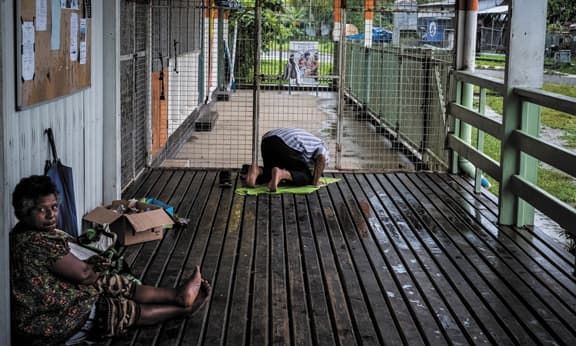
The Manus Island concentration camp is not only the culmination of Australia’s increasingly brutal treatment of refugees over many years. It also epitomises the neo-colonial relationship between Australia and Papua New Guinea.
Colonial powers have long favoured “offshore processing” for unwanted groups of people, far from the support of sympathetic domestic populations or the prying eyes of the media. This of course includes white Australia’s own origins as a penal colony.
Today, PNG’s nominal sovereignty over Manus Island provides a convenient fig leaf for the Australian government, which can leave the sordid details of imprisoning refugees to the local police and military and private contractors. But there is no doubt who really calls the shots.
An Australian colony
The imprisonment of refugees on Manus Island is another chapter in a long history of Australian colonialism in PNG. From 1905, Australia assumed control of British New Guinea, the south-eastern quadrant of the island. To this was added German New Guinea in the north-east, seized as spoils of war in 1914.
Inevitably, Australian colonialism was accompanied by racism and brutal authoritarianism. When local workers went on strike in 1929, one outraged colonialist deprived of his domestic servant fumed, “My coon’s not here”, while another insisted that “the only thing a native understands is a beating”.
Australian capital for the most part failed to develop the PNG economy, with the partial exception of mining. Rio Tinto operated one of the world’s largest copper mines on the island of Bougainville from 1972 until 1989, when it was closed during an armed independence struggle waged by Bougainvilleans who suffered from the mine’s environmental impact but saw little of the profits. On the mainland, BHP owned a giant gold and copper mine that wreaked environmental and social havoc when a tailings dam collapsed in 1984, releasing millions of tons of untreated mining waste into the Ok Tedi and Fly rivers.
Primarily, however, Papua New Guinea was seen by the Australian ruling class, not as an opportunity for profits, but as a strategic problem. This “uncivilised” territory adjacent to Australia needed to be kept out of the hands of rivals to the British Empire such as France, Germany or Japan. World War Two cemented this analysis, with major battles in the territory bringing to a halt the advance of Japanese forces through south-east Asia.
Following the war, Australia hoped to extend its dominion into West Papua, at that time controlled by the Netherlands. Indonesia eventually occupied the territory instead. But the era of direct Western colonialism was coming to an end in any case, many colonies achieving independence in the postwar period. Papua New Guinea eventually joined them in 1975.
Nonetheless, Australia retained significant influence. Australian aid initially amounted to 40 percent of the PNG government budget, and Australian personnel formed the core of the new PNG defence forces. Australia supplied the weapons used by PNG in the military conflict on Bougainville, and eventually oversaw a peace settlement in 1998.
Neo-colonialism and the threat of China
The Australia-PNG relationship entered a new neo-colonialist phase in the early 2000s. Following Australia’s military intervention in East Timor in 1999, Prime Minister John Howard warned of an “arc of instability” stretching from Indonesia through PNG to the South Pacific. This required aggressive action from Australia, to stop any unfriendly powers gaining a foothold in the region.
Having essentially taken over administration of the Solomon Islands in 2003, Australia pressured the PNG government into signing a new bilateral aid treaty in 2004. Decades of Australian aid were alleged to have been wasted by the corruption and mismanagement of the PNG government. Now, so-called “good governance” would be imposed. This supposedly neutral, technocratic term is deeply paternalistic and racist, implying that inept Papuans cannot be trusted to administer their own country.
Several dozen senior Australian officials assumed line management positions in the PNG public service, particularly in areas relating to governance and finance, including the solicitor-general. More than 200 Australian police took control of the PNG police force and were initially granted immunity from prosecution under PNG law, until the PNG High Court ruled this to be unconstitutional. The number of Australian military officers serving within the PNG army also increased. More than a decade on, the intervention continues, without life improving much for ordinary Papuans.
The recently released foreign policy white paper openly reaffirms that a major objective is to ensure “Australia remains Papua New Guinea’s principal security partner”. This stance is bipartisan. Labor’s defence spokesperson, Richard Marles, in October argued that fear of acting “in the manner of an overbearing colonial power” should not stand in the way of a more active Australian policy in the Pacific, to ward off competitors.
Australia’s main rival for influence in PNG is China, which is a source of increasing trade, investment and financial aid. Last month, China and PNG signed deals for infrastructure development as part of Beijing’s massive “One belt, one road” initiative. Chinese aid generally does not come with the sort of strings attached by Australia.
Economic disparity
Economically, Australia overshadows its nearest neighbour. Australia’s gross domestic product per capita, a basic measure of a nation’s wealth, was $48,900 in 2016. PNG’s was just $3,500.
Australian capital invested in PNG totalled $18 billion in 2016, more than from any other country. Bilateral trade with Australia accounts for 26 percent of all PNG’s imports and 16 percent of all its exports. But for Australia, trade with PNG is just 1 per cent of both imports and exports.
PNG is Australia’s largest recipient of overseas aid at $546 million in 2016-17. This amounts to 68 percent of all international aid received by PNG and accounts for 8 percent of the national budget.
Naturally, Australian officials decide how this money is spent, award the contracts and oversee their implementation. In 2017-18, 43 per cent will go to “effective governance” programs. Health and education get 17 and 14 percent respectively, despite the PNG government slashing spending on these essentials in 2017 due to a fiscal crisis.
Manus in context
Given Australia’s economic and political muscle, PNG could hardly afford to refuse prime minister Kevin Rudd’s request in 2013 that refugees be imprisoned on Manus. When Australia cut its foreign aid budget by one-fifth in 2015, PNG was largely exempted, a concession widely seen as a pay-off for Manus.
Australian politicians insist it would be expensive and dangerous to allow the refugees imprisoned on Manus to enter Australia, repeatedly vilifying them as potentially violent criminals. Yet the cost of running the Manus prison has been estimated at $400,000 per year for each individual refugee. Compare this with the roughly $70 per person Australia gives to PNG in aid each year. It isn’t hard to see why some Manus locals, living in poverty and enraged by Australia’s hypocrisy, have come to resent the presence of the refugees.
Of course, the Australian government cares as little about the wellbeing of Papuans, either on Manus or elsewhere, as they do about the refugees themselves. Papuans have long suffered the impact of colonial overlords drawing up arbitrary borders to suit their own ends. Today, refugees detained on Manus Island are the victims of the same imperialist drive to divide the globe without regard to the needs of humanity.
As Israel’s latest brutal war against the people of Gaza drags on, the need to challenge the Zionist state and all those who facilitate its genocidal campaign couldn’t be clearer.
In the latest outburst of national security hysteria, ASIO spy chief Mike Burgess declared, in a speech on 28 February, that an unnamed former Australian politician had betrayed our beloved country by clandestinely working for an evil foreign spy network—which he called “the A-team”—to provide secret information to a rival power.
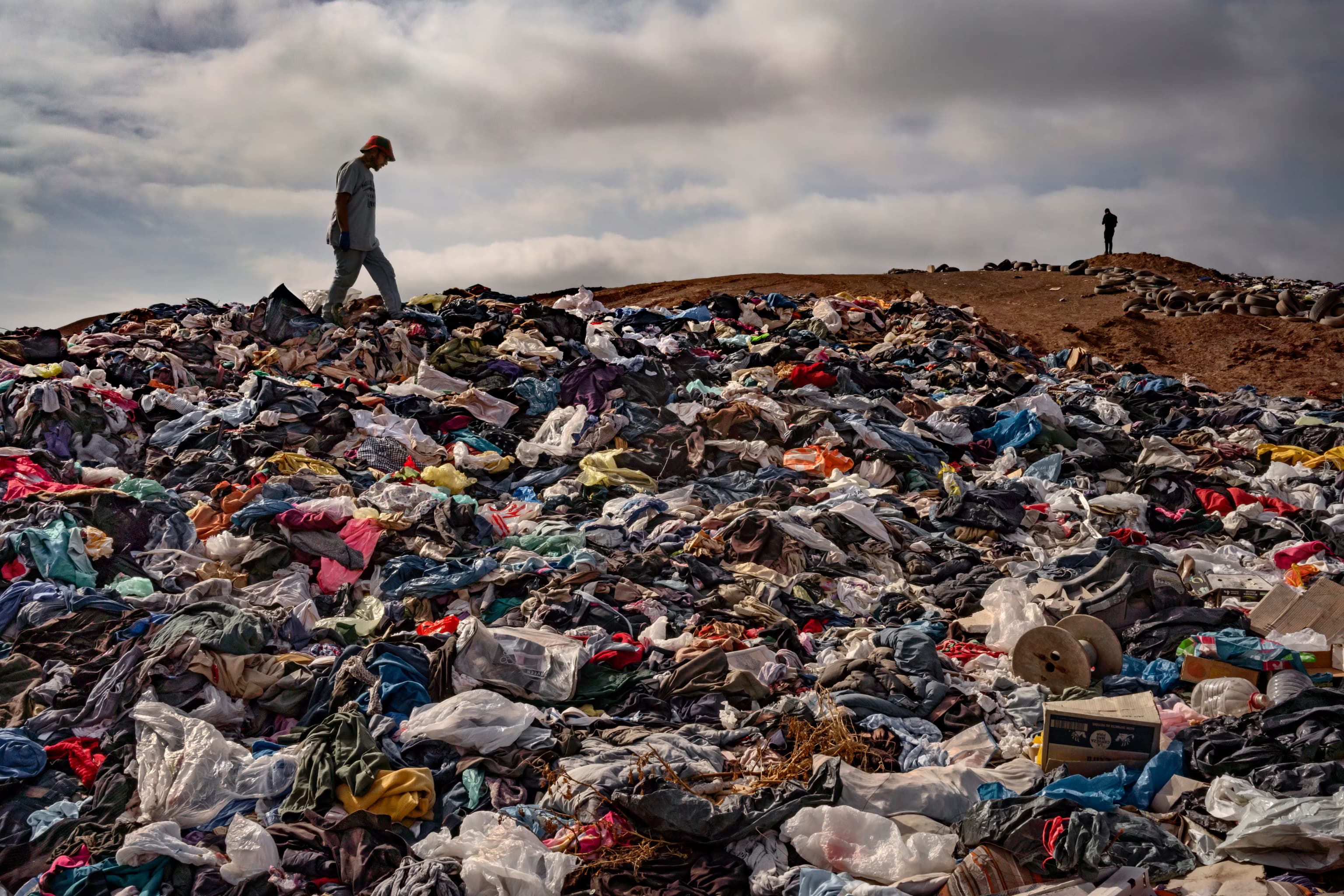
Measured by the sheer volume of stuff produced, capitalism is a very successful system. According to World Bank data, in 1960 global gross domestic product (GDP)—which measures the monetary value of goods and services sold—was just under US$1.4 trillion. By 2022 it had risen to $101 trillion. The world’s population has increased a lot in that time, but the volume of stuff produced has increased by far more.

Banyule City Council has become the eighth metro council in the Melbourne area to formally call for an immediate ceasefire in Gaza.
In a monumental betrayal, Melbourne University’s Students’ Council last month voted to rescind a motion supporting the Palestinian struggle for self-determination and the global Boycott, Divestment, Sanctions movement.
The year is 2070. A global catastrophe—climate change, nuclear winter, civil war: pick your poison—recently ended civilisation and opened a new chapter in your life. So far you’ve ridden it out smoothly in your luxury bunker, but one day you’re swimming laps in the pool, living out your Bond-villain dream, when an alert blinks on your home security console.